MNI POLICY: RBA Shakes Up Forecasting Framework

The Reserve Bank of Australia will implement a wider range of economic models as it shakes up its forecasting framework to help it better navigate unforeseen shocks which it believes may occur more frequently in future amid geopolitical uncertainty, MNI understands.
The Reserve wants the ability to pick the model best suited to navigate the shock being experienced, rather than over relying on a smaller suite of full-system and single equation models. It has allocated extra funding to its forecasting team to rethink how it approaches its entire forecasting framework, a move it believes essential to navigate a future more prone to supply-side or other unforeseen shocks.
MNI reported last year on the breakdown of a number of RBA models driven by the pandemic's impact, such as that noted in the rental market. (See MNI POLICY: RBA Ponders How To Respond To Rental Inflation) RBA officials last year were forced to apply a liberal amount of their own judgement to estimate the neutral levels of interest rates and unemployment. (See MNI POLICY: RBA Applies Judgement On Key Rates As Models Fail)
The RBA now wants to prepare for more unprecedented events, following its experience during and after the pandemic and Russia’s surprise invasion of Ukraine, as the next shock will not resemble the last. It believes supply-driven events may occur more frequently, due to the growing impacts of climate change, the energy transition and the fracturing geopolitical landscape, making the addition of more scenario- and sector-driven models essential.
THE FULL MARTIN
The Reserve launched Hidden PDF in 2018 after a two year development period, with the aim of simplifying its forecasting. The model was created to be flexible enough to incorporate causal mechanisms that policymakers believed important, "while fitting the observable relationships in data reasonably well."
However, MARTIN was not meant to stand alone and works alongside other full-system and single equation models based on historical experience. (See chart)
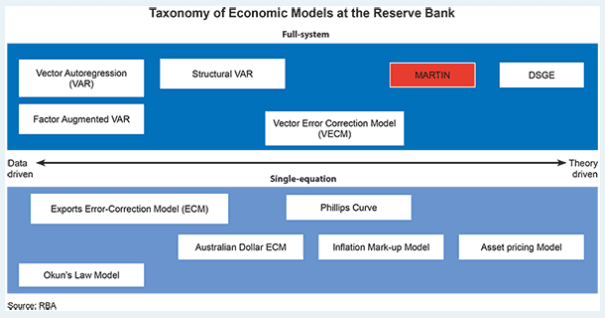
The RBA will look to onboard a range of supply-side models alongside MARTIN, such as former Hidden PDF, and also increase its ability to adapt information that traditional models may not capture. The RBA also wants the ability to integrate better micro data on inflation into forecasts when needed.
The Reserve believes central banks globally have realised full-system forecast models will never provide the whole picture and succeed in handling uncertainty and risk outside more established data sets. The Reserve sees the update of its models as a continually evolving undertaking and not a task it will ever fully complete.
NEW TARGETS
MNI reported this month the RBA’s updated agreement with the federal treasurer will force greater transparency on its inflation and unemployment targets.
The board will make a call at its February meeting on how best to work with the new agreement, MNI understands. The RBA could provide the transparency via a forecast, but this would come with costs and benefits, which the board must weigh before it decides how to comply with the agreement's requirements.
The board will next meet Feb 5-6.


